
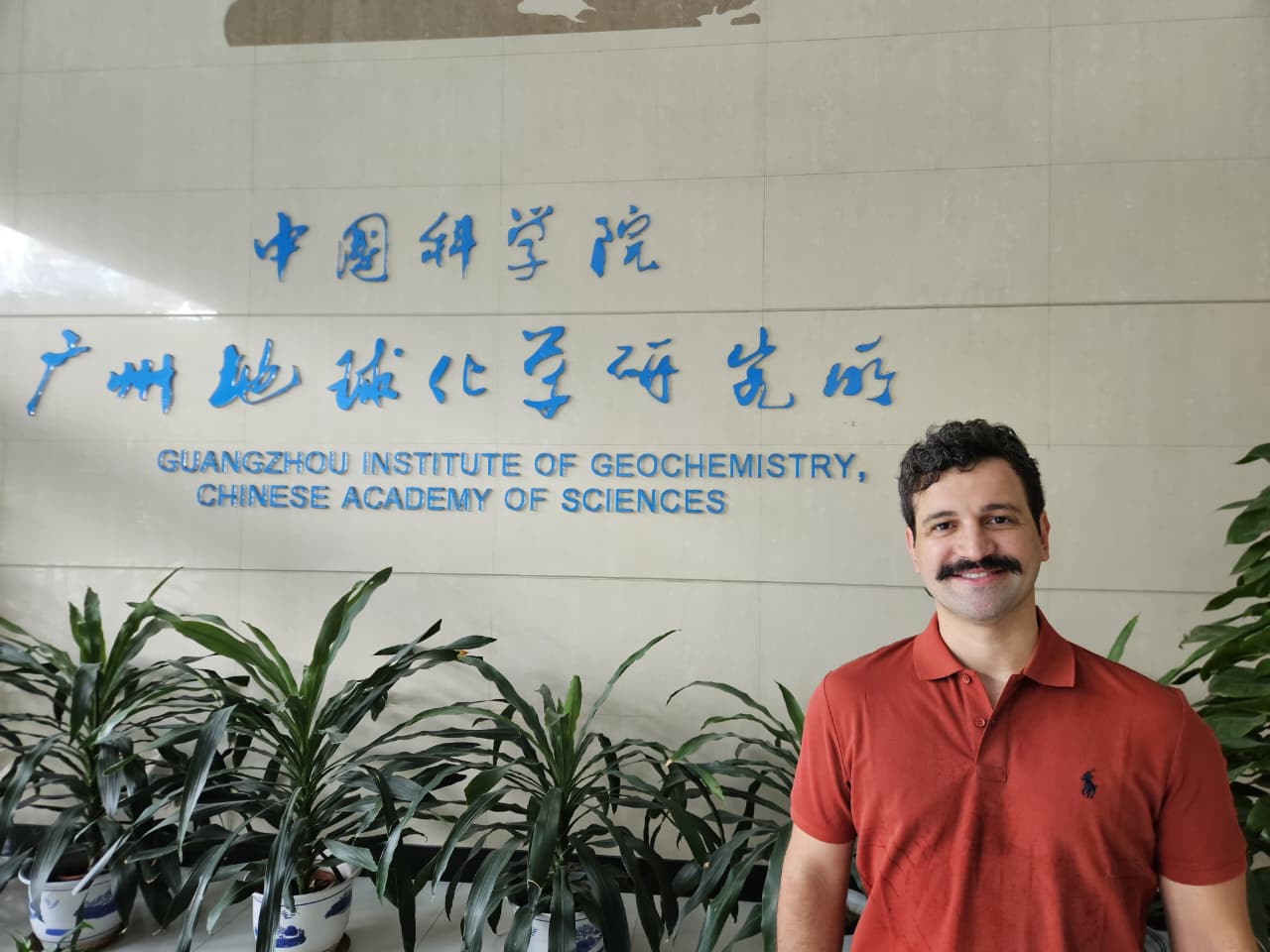
Dr. Yago Guida is a biotechnologist and holds an M.Sc. in Biological Sciences (Biophysics) and a Ph.D. in Sciences from the Carlos Chagas Filho Institute of Biophysics of the Federal University of Rio de Janeiro. For fifteen years he has investigated the occurrence and environmental dynamics of organic and inorganic chemical substances, with emphasis on persistent organic pollutants, and their impacts on environmental and human health. His expertise lies in the development and application of analytical methods for these contaminants in environmental samples and material cycles. He also
works on methodological guidance and national POP inventories, and on the implementation of international treaties for the management and control of chemical contaminants. He has published more than 30 scientific articles and 17 technical documents, among reports, guidance, inventories and implementation plans.
His international experience includes research periods at the Consejo Superior de Investigaciones Científicas in Spain, the Universität Hohenheim in Germany, the Masarykova Univerzita in the Czech Republic and the Università di Siena in Italy, where he worked on the chemical analysis of organic contaminants. From 2022 to 2024 he joined the Material Cycles Division of the National Institute for Environmental Studies in Japan as a Research Associate, and he is now a CAS-PIFI Visiting Scientist
at the Guangzhou Institute of Geochemistry in China. He holds a postdoctoral position at the Institute of Science and Technology of São Paulo State University and collaborates with the Olaf Malm
Environmental Studies Laboratory and the Jan Japenga Micropollutants Laboratory (IBCCF/UFRJ) and with EMBRAPA Environment.
Since 2019 he has worked as an independent consultant for the United Nations Environment Programme, the Stockholm Convention Regional Centre for Latin America and the Caribbean, the Brazilian Ministry of the Environment and Climate Change, and POPs Environmental Consulting.
Between 2019 and 2022 he was the consultant and technical coordinator of the review and update of Brazil’s National Implementation Plan for the Stockholm Convention, and he served as consultant and author on the mercury management project for the Brazilian chlor-alkali sector.
He sits on scientific advisory committees of the Brazilian Ministry of Health, for the National Human Biomonitoring Programme for Chemical Substances, and of the Ministry of the Environment, in the
working group on chemicals in plastics. He is a member of the International Panel on Chemical Pollution (2022–2026), the Japan Society for Environmental Chemistry (2022–2026), The Scientists’
Coalition for an Effective Plastics Treaty (2023–2026), and the Scientific Plastic Pollution Alliance of Chile (2020-2026).